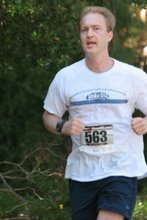
This is a fun one. The two couldn't be more different from one another and yet they both achieve the same goal. For the sake of this post I am assuming marathons on paved roads and ultramarathons on trails.
Distance - This, of course, is the most obvious difference between the two, With the marathon at 26.2 miles and the ultramarathon any distance that is greater than 26.2. For example, a 50k is 31 miles. This doesn't seem like much of a difference, being only 5 miles, but after you've ran that far every mile begins to feel much longer than the previous or longer than the beginning miles.
Elevation - The elevation gain is the kicker when it comes to most ultramarathons since most ultramarathons are trail runs. This results in at least an elevation gain of around 4,500 ft or more. This seems very daunting at first, especially as you've ran half the race and you see a trail that just seems to be continually going up, and up and up. This plays games on your legs as well as with your head as you have to be ready to conquer the hills. How, you might ask? Well you conquer them by walking. If you are planning on winning the race, of course, then you probably are not walking the ascents, but for the average ultramarathoner you are walking virtually every ascent and running every descent.
Time - Because of the elevation gain and the forced walking in order to conserve your energy your average pace slows drastically. This results in a finish time much longer than the marathon. For example, I ran my most resent marathon in 4hrs38min and my 50k in 8hrs15min. A huge difference, and a lot of time spent with yourself and only yourself.
Hydration/Nutrition - In the marathon there are aid stations spread out everywhere, which gives the runner plenty of opportunity to make sure that there are plenty of fluids being drank. In an ultramarathon it is you and the trail with aid stations few and far between. This leaves you with at least one 20oz. water bottle and very possibly two, either handheld or on a hip pack. Because of the length of time you are out there and the energy exerted you drink a ton more fluids than you would during a marathon. Additionally, you need to consume quite a bit more during the race. In a marathon you can get by with a few Gu's if you want or even subsisting only on sports drinks and water. Not so with the ultramarathons, which entails packing some energy bars and other forms to consume a large quantity of calories.
Aid Stations - As mentioned above, the aid stations are few and far in between, leaving you more self sufficient with the ultras. Additionally, when you get to the aid stations you have a whole array of food (such as M&Ms, chips, brownies, potatoes and salt, pretzels and so on) that you can munch on while some volunteers fill your water bottle. With the marathon there is no food and oftentimes the sports drink is watered down to make it spread further (which doesn't absorb as well) and maybe, if you are lucky, you'll get some Gu packets or something. The water is handed to you in little dixie cups with about an ounce in each, which doesn't do much unless you walk through and grab five or six cups.
Your Body - This was the most interesting difference. With the marathon you are pressing a lot harder in order to maximize your time and attempt to achieve a PR. This, of course, stresses you body right off the bat. Then you throw in running on concrete for 26.2 miles and your body takes a beating. The ultramarathon, on the other hand, is run at a slower pace and you have many walk breaks to give your body a rest. The hills utilize different muscle groups so the variation is easier on the legs than running on flat streets where you stress the same muscle group over and over. Ultramarathons, surprisingly, are much easier on the body than a marathon and my recovery time was much faster than after the marathon.
Runners - Marathons, of course, draw a much larger crowd. This makes for your 26.2 miles to be ran almost entirely with someone either around you, in front of you or behind you in sight. There are always people talking and there is the continuous pitter patter of running shoes on concrete. They are also nice but generally stay to themselves. The ultramarathon is usually no more than 100 runners, oftentimes maxing out at 50. Since the race is so long the runners tend to spread out and you can go for hours without coming in contact with another runner, although you can usually see them way off in the distance in front of you or behind you. Additionally, contact is very short, but when you do come across another runner they are very cordial and encouraging.
Course - Marathons are oftentimes run on street with volunteers spread out throughout the whole race guiding you. Ultramarathons are usually trail runs which means you have to keep a vigilant eye out for the little pink, fluttering ribbons warning you of a turn coming up. It is easy to get lost and lose an hour or two and log in some extra bonus miles.
Accomplishment - This is the end goal that is the same in both. You feel you have achieved something with both. But, I must say, the ultramarathon tickled me more than finishing the marathon.
Showing posts with label Versus. Show all posts
Showing posts with label Versus. Show all posts
Wednesday, October 10, 2007


Wednesday, August 1, 2007
2006 SF Marathon vs. 2007 SF Marathon
Okay, so now that I have ran the same Marathon twice, exactly a year apart from one another, and with an actual full year of training, how do they compare? What is the difference? Did I learn anything new?
Hydration - I'll start with the big one, the one that made all the difference in the world. In 2006 I knew nothing about hydration and nutrition. I started the race with a blank slate and figured I would grab a cup of water at every aid station, which I did. So I didn't drink more than I did in the 2007 Marathon. What was the difference then? In 2007 I ran a much faster pace and depleted the water much faster, which of course resulted in my meltdown starting at about mile 17. So hydration sucked for both, but I had a different result in both races. Additionally, I was relying too heavily on the sports drink they provided. From the research I did this time I knew that the concentration had to be measured accurately in order to let your body absorb the sodium, otherwise it is diluted and doesn't get into your muscles fast enough. Well, I noticed that some of the aid stations had very watered down energy drink (since it was made from a powder). Couple this with lack of water and my calves were seriously depleted of sodium. A very bad combination. Lesson? Bring your own water bottles, and the longer runs bring a Camlebak.
Hydration - I'll start with the big one, the one that made all the difference in the world. In 2006 I knew nothing about hydration and nutrition. I started the race with a blank slate and figured I would grab a cup of water at every aid station, which I did. So I didn't drink more than I did in the 2007 Marathon. What was the difference then? In 2007 I ran a much faster pace and depleted the water much faster, which of course resulted in my meltdown starting at about mile 17. So hydration sucked for both, but I had a different result in both races. Additionally, I was relying too heavily on the sports drink they provided. From the research I did this time I knew that the concentration had to be measured accurately in order to let your body absorb the sodium, otherwise it is diluted and doesn't get into your muscles fast enough. Well, I noticed that some of the aid stations had very watered down energy drink (since it was made from a powder). Couple this with lack of water and my calves were seriously depleted of sodium. A very bad combination. Lesson? Bring your own water bottles, and the longer runs bring a Camlebak.

Pace - In 2007 my pace was amazing the first half. I felt like I was running the best race I had ever run. I was keeping an even pace, clocking in at 1:51. With the onset of hydration issues my pace dropped and varied depending on how bad my calves were, gradually getting worse until mile 24, in which case I sped it up to a 10 minute pace. In 2006 I went into it with zero training and was all over the board for each mile. So I learned and executed the pace lesson and was able to apply it to this year.
Chafing - In 2006, without ever running long distances, I had no clue I would encounter chafing. My inner thighs and groin were so chafed I had to walk bowl legged, hobbling around lest the chafing become aggravated. Additionally, my nipples were rubbed raw! So in 2007 I was able to prepare for this, applying Body Glide to all possible chafing areas. Result? No chafing anywhere.

Feet - In 2006 I had purchased brand new shoes two days before running the Marathon. Obviously, I had blisters, although they didn't bother me too much. In 2007 my shoes were fairly new but had at least 75 miles on them, so I only had one blister. Even that was a blister on the exact same toe, in the exact same area that I always get blisters. So with used shoes as well as skin that is toughened up from a year of running, no blisters.
Weather - This plays a huge role on any run. It helped for the better this time. In 2006 we were in a heat wave, and although the morning fog was still there and the temperature was cool, it eventually melted away and left the heat to bare in upon us and make things a bit more difficult. This year, however, it was cold in the morning with fog misting us. This lasted the whole day, even at 11:30 when I left my windows were still being misted by the fog. So the weather definitely helped me run a much better race. But, alas, there really isn't anything I can do about Mother Nature.

Start Line - In 2006 I jumped a few waves ahead and placed myself squarely in the middle of probably a 1,000 people. So when the gun went off it was mayhem as we were herded forward like cattle. There was barely room to move around in the beginning and if you happen to have someone run in front of you that is slower you had to weave and sprint forward and to the side and so on, which uses up more energy. In 2007 I placed myself right at the very front of the wave and waited it out. When the gun went off I had no one in front of me and I was free to run my pace without distraction. It is unbelievable the difference when starting at the front as opposed to the middle or back. Helps immensely.
Feeling - In 2006 I was ecstatic to be running my first Marathon. Granted, I didn't know anything, but I was happy to be there. It felt at the time that my lack of training dropped me straight into hell once I got past mile 5. In fact I was so exhausted and my legs were starting to hurt so much that I almost quit at the half way point. I eventually hobbled/shuffled over the finish line and wasn't sure if I ever wanted to do that again. Now move to 2007. I was even more excited to be there this time as I actually felt prepared and ready, eager to run. The first half I didn't feel winded and my legs didn't feel tired at all until dehydration kicked in and sapped my calves strength. When this happened it was perhaps the worst pain I had ever felt. Every step was a grunt exhaled. The pain level was 10 times worse than in 2006, even though I was in much better shape. Eventually I was able to get enough sodium and water into the system to resume running and was able to finish strong, which was different from the year previous.
Soreness - 2006 I was of course chafing, which hurt a couple of days. My knees were in pain for a week, and my legs were exhausted for the better part of the second week. One interesting muscle that surprised me that was extremely sore was my trapezius muscle, or the muscle between your neck and shoulder. 2007, though, I felt a little soreness in the meniscus of my right knee, but other than that I don't feel any lasting soreness as of right now, three days after. I briefly felt sore the day after the race in my trapezius, but that went away quick because I had been working that muscle out for a year now and it is conditioned.
Feeling - In 2006 I was ecstatic to be running my first Marathon. Granted, I didn't know anything, but I was happy to be there. It felt at the time that my lack of training dropped me straight into hell once I got past mile 5. In fact I was so exhausted and my legs were starting to hurt so much that I almost quit at the half way point. I eventually hobbled/shuffled over the finish line and wasn't sure if I ever wanted to do that again. Now move to 2007. I was even more excited to be there this time as I actually felt prepared and ready, eager to run. The first half I didn't feel winded and my legs didn't feel tired at all until dehydration kicked in and sapped my calves strength. When this happened it was perhaps the worst pain I had ever felt. Every step was a grunt exhaled. The pain level was 10 times worse than in 2006, even though I was in much better shape. Eventually I was able to get enough sodium and water into the system to resume running and was able to finish strong, which was different from the year previous.
Soreness - 2006 I was of course chafing, which hurt a couple of days. My knees were in pain for a week, and my legs were exhausted for the better part of the second week. One interesting muscle that surprised me that was extremely sore was my trapezius muscle, or the muscle between your neck and shoulder. 2007, though, I felt a little soreness in the meniscus of my right knee, but other than that I don't feel any lasting soreness as of right now, three days after. I briefly felt sore the day after the race in my trapezius, but that went away quick because I had been working that muscle out for a year now and it is conditioned.

Summation - As a friend pointed out, a Marathon is the whole package, so if I screwed up my hydration, well I can't blame that, because that was a huge part of the preparation that went into my training. So, hydrate yourself, apply body glide, train hard, wear shoes that are worn in, try to start near the front of your wave or the start line and focus on maintain a steady pace.
This was what I learned from this Versus.
Subscribe to:
Posts (Atom)